
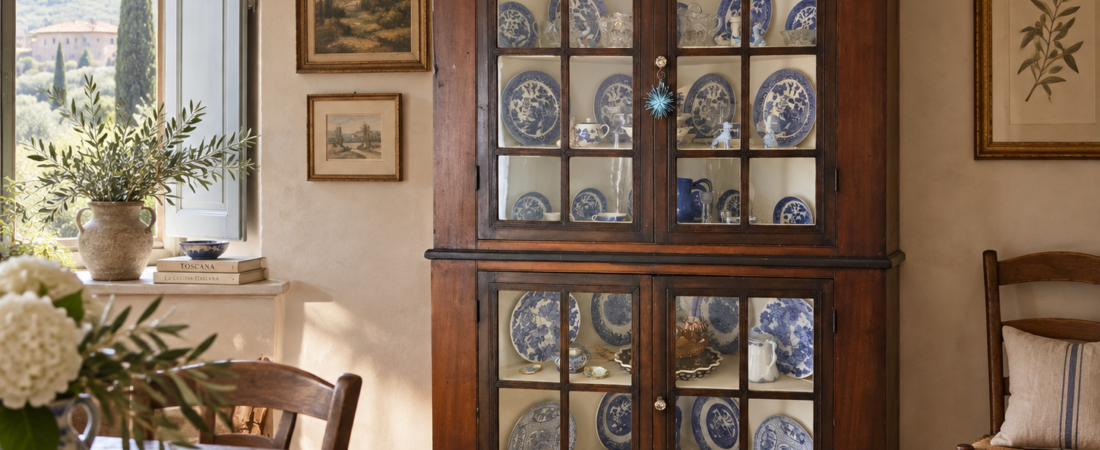
A Piece of Furniture Meant to Hold a Family’s Best
Walk into almost any Italian home built before the 1980s — grand or modest, in a city apartment or a farmhouse in the countryside — and you’ll very likely find a cristalliera somewhere in the living room. A tall cabinet, usually in dark, well-worked wood, with glass panels on the front and sometimes the sides, standing against a wall like a small monument to the family that owns it.
It’s rarely just furniture. For generations, the cristalliera was one of the most meaningful objects an Italian household could have — not because of what it cost, but because of what it held.
A Cabinet Meant to Be Seen, Not Just Used
Most furniture exists to be useful first. The cristalliera flips that idea. Its entire purpose is display: the glass front isn’t there to protect what’s inside so much as to show it off. Whatever sat behind that glass was meant to be seen, admired, and rarely, if ever, actually used.
This is what set it apart from an ordinary cupboard. A credenza stored things you needed. A cristalliera stored things you were proud of.
Rich or Poor, Every Home Had One
What makes the cristalliera such an interesting piece of Italian domestic history is how little it depended on wealth. In grander homes, it might be an elaborate piece with carved detailing and beveled glass. In more modest houses, it could be simpler — smaller, plainer, built by a local craftsman rather than a famous workshop. But the idea behind it stayed exactly the same.
Even families with very little set something aside for the cristalliera. It wasn’t about how much you had. It was about having something worth keeping for best.
Good Wood, Honest Craftsmanship
Because the cristalliera was meant to last — and to be looked at daily — it was rarely built carelessly. Solid wood was standard: walnut, cherry, oak, depending on the region and the era. The glass panels were often cut and fitted by hand, sometimes with a slight decorative etching or a soft wave to the pane that catches the light differently than modern flat glass.
Even in simpler versions, there’s usually a level of care in the joinery and detailing that mass-produced furniture rarely bothers with today. It was built by someone who expected it to still be standing in fifty years — and in a great many homes, it still is.
What Went Inside: The Good Set
Every Italian family of a certain generation had “il servizio buono” — the good set. Plates that came out only for Christmas, Easter, or an important guest. Glasses reserved for a toast, not for everyday water. A coffee and tea service, often with gold trim, that might be used only a handful of times a year.
All of it lived inside the cristalliera. Not hidden away in a drawer, but arranged carefully behind the glass, where it could be seen even on an ordinary Tuesday when no one was using it. In a strange way, that was the point: the good china didn’t have to be in use to be worth having on display. Its presence alone said something about the household.
The Lace Beneath the China
Look closely at an older cristalliera and you’ll often find that each shelf is lined with a strip of lace or crochet trim — usually handmade, usually by a grandmother, mother, or aunt somewhere in the family’s past. These weren’t bought to match a set. They were made by hand, often over months, and passed down along with everything else the cabinet held.
It’s a small detail, easy to miss, but it says as much about Italian domestic life as the china itself: even the shelf lining deserved to be made with care, by hand, by someone who loved the people who would eventually own it.
A Word Without a Perfect Translation
In English, a cristalliera is usually translated as a “china cabinet” or a “glass display cabinet.” Neither term quite captures it. A china cabinet, in most English-speaking homes, is a fairly plain piece of purely practical storage. The cristalliera carries more weight than that — sentimental, generational, tied to specific memories of specific relatives.
Interestingly, English speakers who fall in love with Italian antiques often end up borrowing the Italian word itself rather than settling for a translation, simply because nothing else fits quite as well. Language has a way of keeping words alive when the object they describe is more than the sum of its function.
The Cristalliera Today
Fewer new homes in Italy are built around a cristalliera the way they once were — open shelving and minimalist interiors have taken over plenty of modern living rooms. But the old cabinets haven’t disappeared. Many are still standing in family homes, passed down along with whatever china and lace came with them. Others have found their way into antique shops and vintage markets, discovered by a new generation drawn to the same thing that made them special in the first place: the sense that an object can hold more than china. It can hold a family’s history.
If you ever find yourself in an Italian antique market, it’s worth pausing at a cristalliera, even briefly. Somewhere behind that glass, for decades, sat a family’s best — waiting, mostly unused, simply to be seen.
For more on the details that give a home its Italian feeling, read our guide to what makes a home feel Italian.